
Agentic AI Platforms That Think, Plan & Execute for You
We build automation, prediction and decision support directly into enterprise workflows — AI as part of the platform, not a bolted-on chatbot. From process automation to predictive analytics, intelligence that works where the business actually operates.
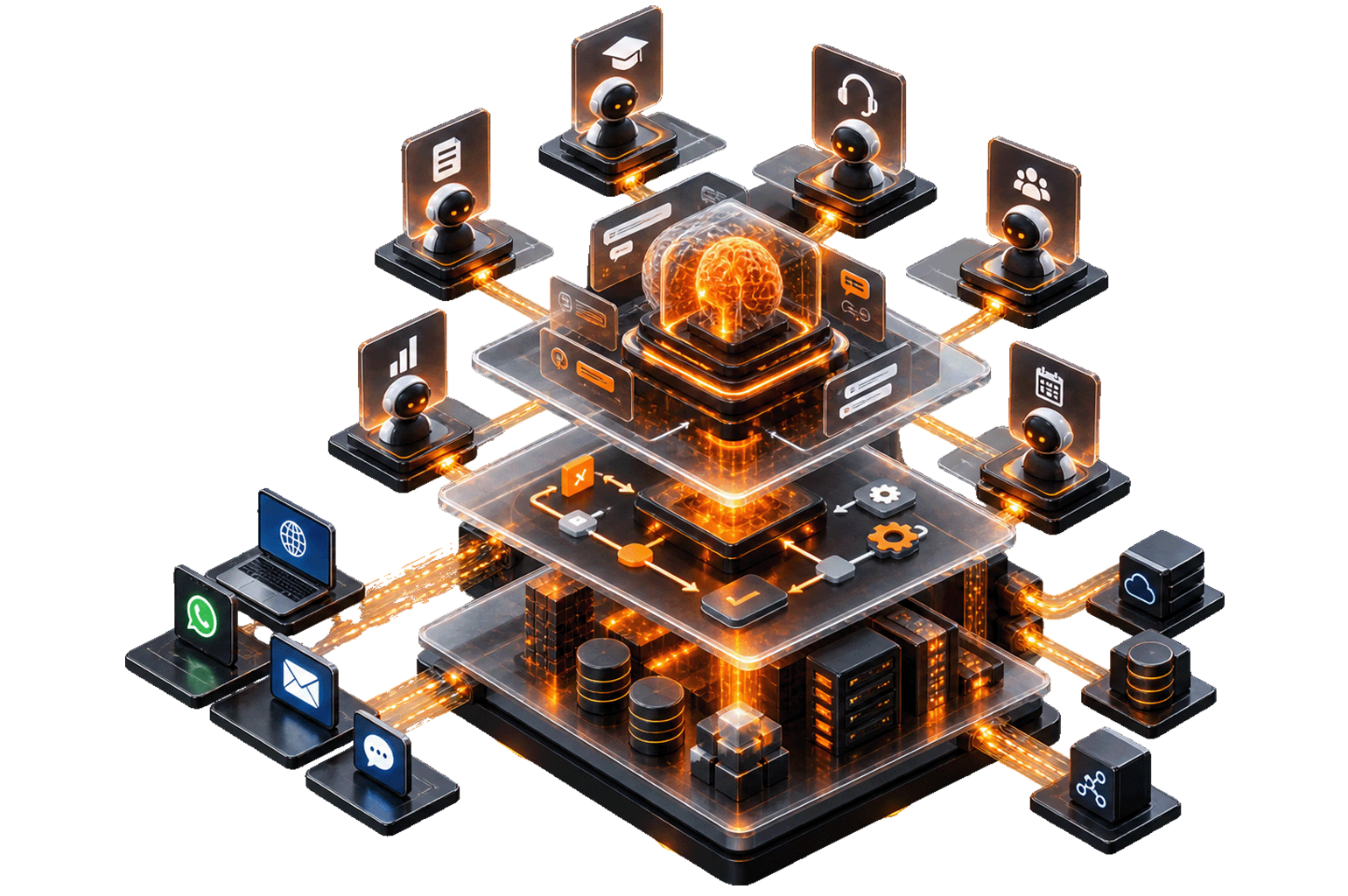
Intelligence embedded into how the business actually runs.
Traditional automation is effective when the process is predictable.
AI extends that capability where workflows also require prediction, contextual decisions, conversational access or coordinated multi-step execution.
Malayan Tech Labs engineers AI directly into enterprise platforms and operational workflows so intelligence can work with the data, systems and approval structures the business already uses.
Four capability pillars within one AI & automation practice.
The practice is focused on four substantial areas: automating manual operational work, forecasting from operational data, embedding conversational access into tools, and surfacing decision-ready signals across the business.
Intelligent Automation
Rules-based and AI-assisted automation of repetitive operational work across enterprise processes.
Predictive Analytics
Forecasting, demand planning and anomaly detection built from available operational and historical data.
AI Assistants & Conversational Interfaces
Conversational access embedded into internal tools and customer-facing channels, connected to relevant business data and workflows.
Decision Intelligence
Decision-support experiences that surface operational signals, recommendations and exceptions for faster, better-informed action.
Beyond automation — AI that can plan and execute within defined boundaries.
Agentic AI is appropriate when a workflow requires more than a fixed rule or a single response. Given a defined goal, an agent can plan a sequence of actions, use approved tools and systems, check results and escalate where human approval is required.
Multi-Step Task Execution
Agents that coordinate a sequence of workflow steps — such as processing a request, retrieving information, updating records and notifying stakeholders.
Tool & System Orchestration
Agents that work through approved APIs, databases and enterprise systems to complete defined tasks across connected environments.
Goal-Directed Planning
Agents that break an objective into actions, evaluate intermediate results and adjust the next step when the workflow changes.
Human-in-the-Loop Oversight
Approval checkpoints, permission boundaries and action logs that keep higher-impact decisions reviewable and controllable.
The control structure around an enterprise agent.
The architecture separates planning, tool access, working context and oversight so the agent operates through defined interfaces rather than unrestricted access to business systems.
Planner / Orchestrator
Specialist Execution
Context & State
Validator & Guardrails
Enterprise Systems & APIs
Human Approval Boundaries
How an agent works through a task.
A governed agentic workflow follows a repeatable cycle from understanding the task to validating the outcome, with approvals introduced where the process requires them.
Perceive
Plan
Act
Verify
Escalate / Continue
How AI capability connects across the stack.
AI capability sits on top of the same operational data and workflows that run the business — shaped by the data available, made functional through models and automation logic, then connected back into the platforms people actually use.
From raw operational data to applied intelligence.
Intelligence is only as useful as the workflow it sits inside. Malayan’s approach starts from the data already available, applies models and automation logic on top, then embeds the result back into the tools and processes people use every day.
Operational Data
Models & Automation Logic
Embedded Intelligence
Business Outcomes
AI that operates with defined controls around it.
Enterprise deployment requires more than model capability. The workflow needs clear access boundaries, review points, traceability and integration with the systems already responsible for business operations.
Permissions & Access
Limit data, tools and actions to what the workflow requires, using the access controls of the surrounding enterprise environment.
Approval Boundaries
Introduce human review before higher-impact or exception actions proceed, rather than treating every step as autonomous.
Auditability
Capture key actions, decisions and workflow outcomes so behaviour can be reviewed, investigated and improved.
Enterprise Integration
Deploy intelligence through controlled APIs and application workflows instead of giving models unrestricted access to core systems.
Where AI & automation can create operational value.
These are representative applications of the capability — examples of the kinds of workflows Malayan can assess and engineer, not claims about specific client deployments.
Exception handling
Detect an operational exception, gather the relevant records, recommend or trigger the next approved action, and route anything outside policy for review.
Document processing
Extract structured information, validate it against defined business rules, and move approved data into the appropriate enterprise workflow.
Operational forecasting
Use historical and current signals to surface demand, workload, capacity or anomaly indicators for planning teams.
AI-assisted system interaction
Let authorised users retrieve information or initiate approved workflows conversationally without bypassing the underlying application controls.
Three AI & automation pathways.
The same engineering capability can be applied to automate an existing process, add intelligence to a platform already in use, or evaluate a bounded agentic workflow through a structured pilot.
Automate a manual or repetitive operational process.
Apply rules-based automation and AI where appropriate to remove repetitive work from an existing process without rebuilding the underlying system.
- Reduce manual processing
- Improve consistency in repetitive tasks
- Increase operational throughput
Add prediction and decision support to a platform you already run.
Layer forecasting, recommendations or conversational access on top of an existing enterprise system where the available data supports it.
- Forecasting and anomaly detection
- Embedded recommendations
- Conversational access to existing data
Evaluate a bounded agentic workflow before broader deployment.
Define one suitable business workflow, establish permissions and approval points, build a controlled pilot and evaluate operational value and risk.
- Workflow decomposition
- Agent and integration design
- Controlled pilot implementation
- Outcome and risk assessment
AI as an intelligence layer across the wider Solutions portfolio.
AI & Automation doesn’t operate in isolation — it draws on the same platforms, data and infrastructure as Malayan’s other capabilities, and strengthens each of them in turn.
Ready to put AI to work inside your operations?
Talk to Malayan about where automation or applied intelligence could remove manual work or sharpen decision-making in your business.