
01
Enterprise System Integration
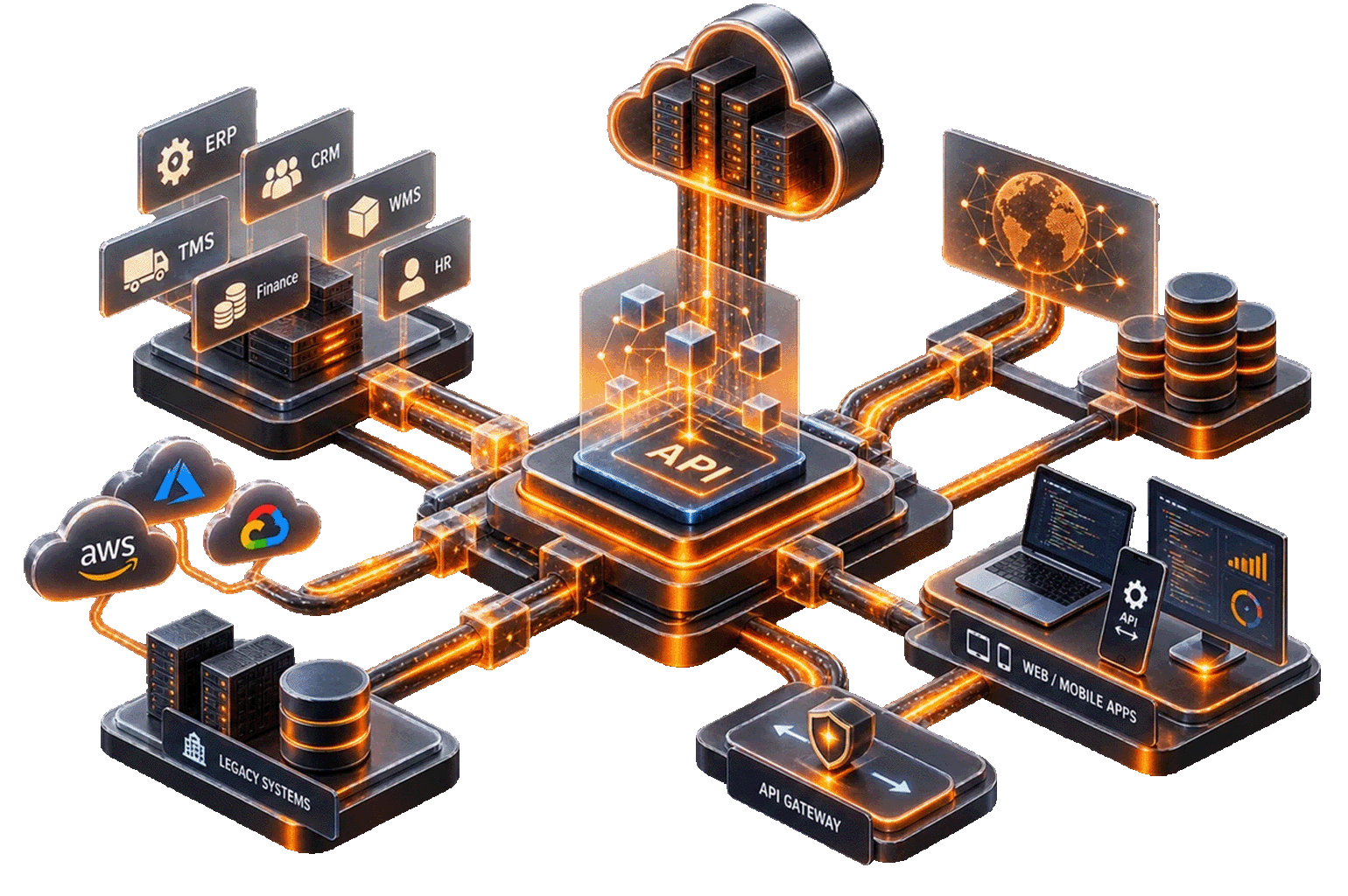
Connect ERP, CRM, finance, logistics, HR, operational and custom platforms through defined interfaces and integration workflows that preserve process continuity across systems.
We engineer the integration layer between enterprise applications, data platforms, partners and digital channels — creating secure, governed and observable connections that keep information and business processes moving reliably.
Integration is the connective layer between applications, data and business processes.
Without a deliberate architecture, organisations accumulate point-to-point dependencies, duplicated data, manual handoffs and interfaces that become difficult to change safely.
Malayan designs and engineers integration solutions that connect modern applications, legacy platforms, cloud services, data stores and external partners through stable interfaces and controlled information flows.
The architecture is shaped by business criticality, transaction patterns, security boundaries, data ownership and change frequency — so the integration model supports both current operations and future platform evolution.
We cover the architecture and engineering required to expose capabilities safely, move data reliably and reduce brittle dependencies between systems.
Connect ERP, CRM, finance, logistics, HR, operational and custom platforms through defined interfaces and integration workflows that preserve process continuity across systems.
Design and implement internal, partner and customer-facing APIs with clear contracts, lifecycle controls, authentication, versioning and documentation.
Move and synchronise information using request-response, messaging, event-driven and scheduled patterns selected according to latency, consistency and resilience requirements.
Bridge older applications and external ecosystems without forcing immediate replacement — using adapters, gateways and controlled interfaces to isolate complexity and reduce coupling.
The architecture separates business systems from the connectivity layer so interfaces can evolve without every application becoming directly dependent on every other application.
A clear integration layer creates reusable interfaces, controlled data movement and better visibility into how transactions cross system boundaries.
Controls apply across systems, interfaces and services rather than appearing only at the end of the transaction flow.
Not every integration should behave the same way. We select patterns according to transaction criticality, response time, data volume, system ownership and tolerance for temporary failure.
Immediate request-response interfaces for transactions and digital experiences that depend on a direct answer between systems.
Loosely coupled event flows that propagate business changes without forcing every consuming system into a direct dependency.
Controlled movement and reconciliation of reference, transactional and reporting data where consistency and ownership must remain explicit.
Secure interfaces for customers, suppliers, platforms and ecosystem partners with explicit authentication, validation and boundary controls.
We avoid creating a new integration problem while solving an old one. Interfaces are designed to reduce unnecessary coupling, keep ownership clear and make change safer across the wider platform.
Enterprise integration needs clear rules around who can connect, what data can move, how interfaces evolve and how failures are traced across system boundaries.
Authentication, authorisation and trust boundaries are designed around the systems and parties allowed to call each interface.
Defined request, response and compatibility rules reduce unexpected breakage as applications and consumers change over time.
Validation, transformation and exposure rules keep sensitive or system-specific data from moving across boundaries without purpose.
Logs, metrics, correlation and failure visibility help teams understand how transactions move across distributed services.
The delivery model starts with business flows and system dependencies, then moves through target architecture, interface engineering, validation and controlled transition.
Identify applications, interfaces, data owners, business processes, dependencies, pain points and operational constraints.
Select interaction patterns, integration boundaries, API contracts, security controls and the target connectivity architecture.
Implement APIs, adapters, transformations, events and orchestration around the agreed contracts and ownership model.
Validate functional flows, failure handling, security, performance, data consistency and downstream impact before release.
Document interfaces, ownership and support paths, then transition the integration layer with monitoring and change controls in place.
These examples illustrate common integration problems the practice is designed to address. They are representative scenarios, not claims of specific client deployments.
Connect operational platforms with CRM, finance, HR, warehouse, transport or other business systems while keeping ownership and transaction boundaries clear.
Expose controlled services to customers, vendors, payment providers, logistics partners or external platforms without opening internal systems directly.
Introduce stable interfaces around older platforms so new applications can connect without requiring immediate replacement of the underlying system.
Coordinate master, transactional and reporting data across applications to reduce duplicate entry, conflicting records and manual reconciliation.
An engagement can begin with a new integration foundation, an existing environment that needs to be untangled, or business capabilities that need to be exposed safely to new channels and partners.
Create the architecture, interface standards and reusable connectivity patterns needed as the application landscape expands.
Restructure existing interfaces, isolate legacy complexity and introduce clearer ownership around data and service boundaries.
Design secure APIs for mobile apps, portals, partners, automation and other digital channels without exposing internal complexity.
System Integration & APIs connects the applications, cloud platforms, intelligent services and digital channels Malayan engineers — allowing each capability to operate as part of a coordinated enterprise environment.
Talk to Malayan about integration architecture, API engineering, legacy connectivity and the governed information flows behind connected enterprise platforms.